In modern machining, the quality of a CAM program depends on much more than toolpath strategy. A CAM system can generate efficient motion, but the result is only as reliable as the cutting-tool data behind it. If the tool geometry is incomplete, the holder is selected incorrectly, the insert grade is unsuitable, or the programmed cutting parameters do not match the real assembly, the shop floor may face chatter, collisions, poor tool life, or dimensional inaccuracy. ISCAR’s NEOITA platform addresses this challenge by connecting tool recommendation, digital catalog data, and tool assembly configuration into a more complete workflow. By integrating with ISCAR’s electronic catalog and assembly options, NEOITA helps users move from tool selection to CAM-ready results with greater confidence.
NEOITA, ISCAR’s digital tool advisor environment, is designed to support machinists, CAM programmers, and manufacturing engineers in selecting cutting tools and machining data for specific applications. Rather than forcing users to search manually through catalogs, compare insert families, calculate parameters, and then build a tool assembly from scratch, NEOITA guides the process based on machining requirements. The user can define material, operation type, machining conditions, workpiece features, and performance goals. From there, the system recommends suitable ISCAR tools, inserts, grades, holders, and cutting conditions.
The value of NEOITA becomes especially important when its recommendations are connected to ISCAR’s electronic catalog. A traditional paper catalog provides technical information, but the programmer still has to interpret it, transfer dimensions manually, and verify compatibility. The electronic catalog, by contrast, offers structured digital data. Tool dimensions, insert information, holder geometry, ordering numbers, clamping details, and application ranges can be accessed in a consistent format. When NEOITA draws from this catalog environment, recommendations are not generic suggestions; they are based on actual catalog items that can be purchased, assembled, measured, and programmed.
This integration reduces one of the most common sources of CAM error: mismatched or incomplete tool data. In CAM programming, the cutter definition must reflect the real tool. For milling, this includes cutter diameter, corner radius, cutting length, overall projection, flute length, shank diameter, and holder dimensions. For turning, it includes insert shape, nose radius, holder orientation, approach angle, and clamping style. For drilling and holemaking, it includes drill diameter, point geometry, body length, usable depth, coolant configuration, and connection type. When these details are manually typed into CAM, mistakes are easy. A wrong radius or projection length can create incorrect stock allowance, poor simulation, or even a crash. By using catalog-based data, NEOITA helps ensure that the tool definition begins from verified product information.
Another important advantage is compatibility. Cutting tools are not individual items in isolation; they are systems. An insert must fit the pocket. A cutter body must match the correct insert size and screw. A modular head must match the correct shank or adapter. A boring bar must accept the selected cartridge. A toolholder must fit the machine spindle or turret interface. NEOITA’s connection with ISCAR assembly options supports this system-level thinking. Instead of selecting a cutting edge and leaving the rest to assumption, users can configure a complete assembly that reflects the way the tool will actually be mounted on the machine.
This complete assembly concept is essential for reliable CAM simulation. CAM systems do not only simulate the cutting edge. They also simulate the holder, arbor, shank, extensions, and adapters, especially in 3-axis, 5-axis, mill-turn, and deep-cavity operations. If the CAM model includes only the cutter but not the full holder assembly, collision checking is incomplete. The toolpath may appear safe on screen but fail on the machine because an adapter, chuck, or holder body contacts the workpiece, fixture, or machine component. By connecting NEOITA recommendations to assembly data, ISCAR helps users create digital tool assemblies that are closer to the real physical setup.
The integration also supports better decisions about tool reach and rigidity. In many machining operations, the temptation is to select a long tool to reach a difficult feature. However, excessive overhang reduces stiffness and can lead to vibration, poor surface finish, and shortened tool life. A digital assembly environment allows the programmer to evaluate the needed projection, holder style, and modular connection before generating the CAM program. NEOITA can guide tool selection based on the operation, while the electronic catalog and assembly options help validate whether the selected combination provides the necessary reach without unnecessary length. This improves both productivity and process security.
Cutting data is another area where NEOITA’s integration improves CAM reliability. CAM software requires feeds, cutting speeds, stepovers, depths of cut, and sometimes more advanced parameters such as chip thickness, ramping limits, entry strategies, or coolant recommendations. If the programmer uses overly conservative data, productivity suffers. If the data is too aggressive, tool failure may occur. NEOITA can recommend application-based cutting conditions that correspond to ISCAR’s tool families, insert grades, workpiece materials, and operation types. Because these recommendations are tied to real catalog products, they provide a stronger starting point than estimates or legacy shop assumptions.
This is particularly useful when machining difficult materials. Stainless steels, hardened steels, titanium, nickel alloys, cast iron, aluminum, and composite materials all require different grades, geometries, coatings, and cutting strategies. Even within one material group, the ideal recommendation may change depending on whether the operation is roughing, finishing, slotting, profiling, drilling, grooving, threading, or parting. NEOITA helps narrow the choice, while the catalog verifies the tool family and assembly components. The CAM programmer can then apply cutting conditions that are more aligned with the selected tool’s actual design intent.
The connection between tool selection and CAM output also supports standardization. Many shops struggle with inconsistent programming practices. One programmer may use one tool family, another may use a different holder, and a third may enter custom data manually. Over time, the tool crib becomes crowded with similar tools, setup sheets become inconsistent, and troubleshooting becomes harder. A NEOITA-driven workflow can help standardize tool choices around approved ISCAR products and assemblies. When programmers use the same catalog-based tool data and assembly logic, CAM programs become more repeatable and easier to verify.
Assembly options also help bridge the gap between engineering, programming, purchasing, and the shop floor. A CAM programmer may select a tool digitally, but purchasing needs order numbers, the tool crib needs components, and the machinist needs to assemble the tool correctly. By relying on ISCAR’s electronic catalog data, the digital recommendation can be connected to actual item numbers and assembly components. This reduces ambiguity. The selected tool is not just “a 12 mm end mill” or “a face mill with carbide inserts”; it becomes a specific ISCAR assembly with defined components, dimensions, and recommended use.
For CAM verification, accurate tool assemblies support more dependable simulation and post-processing. In high-value machining, especially aerospace, die and mold, medical, automotive, and energy components, simulation is a critical step before machining. A toolpath that avoids gouging with the cutting edge but ignores the holder is not fully verified. A tool assembly exported or recreated from catalog-accurate data allows the CAM environment to check the entire tool envelope. This helps detect interference risks early, before they become machine downtime or scrapped parts.
NEOITA also contributes to faster process planning. Instead of searching separately for a tool, checking catalog dimensions, confirming insert compatibility, calculating cutting data and power consumption, and then manually building an assembly in CAM, users can work through a more connected selection process. The fewer disconnected steps there are, the lower the chance of error. This speed matters in job shops and production environments alike. Job shops need quick turnaround on new parts, while production shops need stable processes that can be optimized and repeated.
Another benefit is knowledge transfer. Experienced machinists often know which tools work best, but that knowledge may not be documented. New programmers may lack the same familiarity with tool families, grades, or application limits. NEOITA helps encode ISCAR’s tooling knowledge into a guided digital workflow. When paired with catalog and assembly data, it becomes not only a recommendation system but also a practical learning environment. Users can see which tool is recommended, what components belong to it, and what cutting conditions are appropriate.
Ultimately, the purpose of integrating NEOITA with ISCAR’s electronic catalog and assembly options is to improve confidence in CAM results. Reliable CAM depends on accurate tool geometry, valid cutting data, correct component compatibility, realistic holder representation, and practical machining recommendations. NEOITA supports the decision-making process, the electronic catalog supplies verified product information, and assembly options ensure that the digital tool reflects the physical tool used on the machine.
In this way, ISCAR’s digital ecosystem helps close the loop between tool selection and actual machining performance. The CAM program is no longer based on approximations or disconnected manual entries. It is built around recommended tools, verified catalog data, and complete assemblies. That combination improves simulation accuracy, reduces programming errors, supports better cutting conditions, and increases the likelihood that what is proven in CAM will perform successfully on the machine. For manufacturers seeking higher productivity, fewer surprises, and stronger process reliability, the integration of NEOITA with ISCAR’s electronic catalog and assembly tools is a significant step toward assured CAM results.


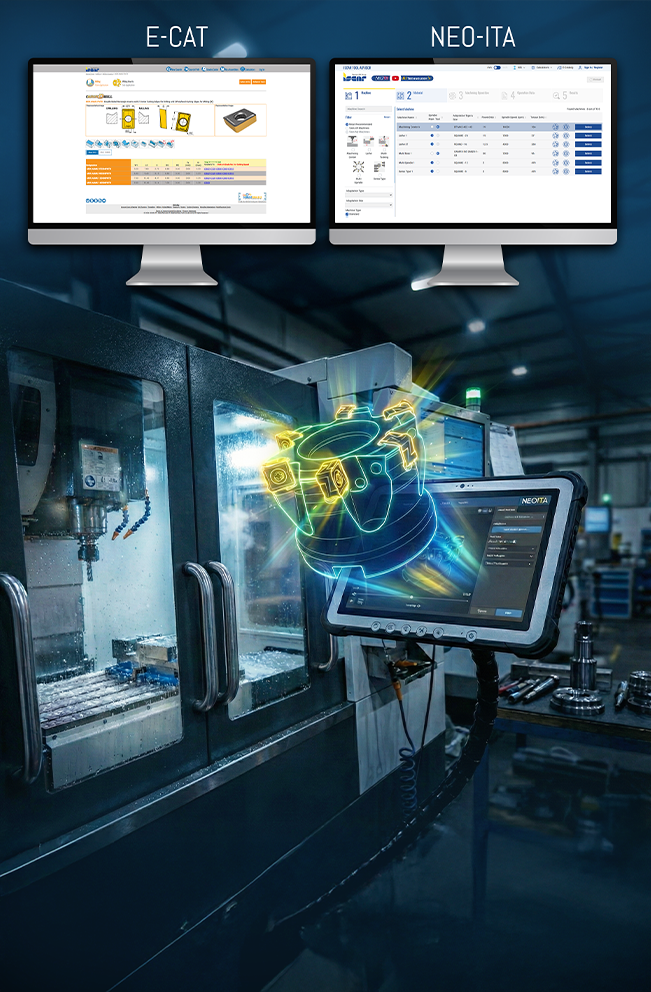 Fig1_NEOITA